

We set up Inkani Wellness with the goal of fostering and supporting the growth of functional medicine, other forms of holistic evidence-based medicine and the biohacker community in India. We’re committed to providing easy access to the best diagnostics and tools required by functional medicine practitioners, biohackers and anybody looking to upscale their health.
Access to consistently accurate diagnostic tools that you can rely on is very important in this context. Accuracy of diagnostic data is something we take very seriously at Inkani and can’t make any compromises on.
For advanced tests like gut microbiome, genetics, biological age etc the limited options available in India don’t meet our standards. So we headed overseas and partnered with the best international labs for each respective test.
When it comes to simple blood tests though, that’s not an option. We can’t be shipping out samples overseas every time anyone wants a blood panel.
For quite a while now, we’ve been investigating different labs in India to identify ones that meet our standards. We’ve found that the quality control in some of these labs is very concerning and we couldn’t trust their data.
We’re not the only ones saying this. The issue of faulty lab data has been raised often in the Indian health community. We’ve heard some scary anecdotes ourselves. You can a lot of these on various online forums too if you start digging.
Luke Coutino, a popular integrative medicine practitioner made an Instagram post yesterday where he raised the same issue. We had commented on it echoing his concerns and talking about an experiment that we ran recently.
There’s been an overwhelming inflow of DMs inquiring about it and asking for the full report of the experiment ever since (our social media intern had a mini breakdown yesterday). So we decided to go ahead and break the full story with this blog post and share the report publicly for everyone to access.
The Experiment
What is this experiment we speak about? While our team has been running multiple investigations here and there to gauge the quality of different diagnostic labs, the most heroic endeavour so far was taken up by Yohan Tengra, a functional medicine practitioner- one of the best in the country- who’s been leading our research efforts at Inkani.
On 4th August 2024, Yohan sent the same sample- his own, to 12 different labs- Apollo, Metropolis, Lalpath, 1Mg, Aarthi, Agilus, Redcliffe, iGenetic, Orange Health, Healthians, Maxlab, and Thyrocare.
All of these labs are available for online booking.
The first collection was done at 10:15 am at Yohan’s Mumbai residence, which was sent to Metropolis, Lalpath and Orange. A second collection, done at 10:45 was sent to the rest of the 9 labs.
How Much Error Is Acceptable?
Analysing blood is a difficult process. There are a lot of factors affecting the results- not all of which are easy to fully control. So a variation of up to 5 per cent is known to be pretty standard. Up to 10 per cent is subpar but still acceptable. Beyond 10 per cent is unacceptable.
Assessing Results
Unsurprisingly, a lot of the results we received fell into the unacceptable category. Some of them even go above 20 per cent. You can download and check out the full report here.
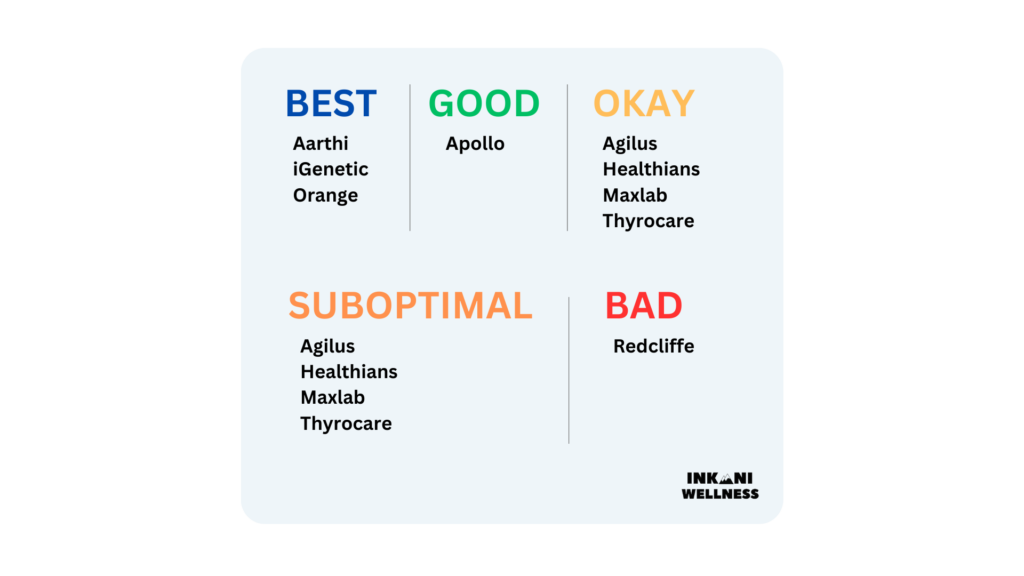
The reports from Aarti, Orange and iGenetic were found to be the most accurate. We’ve classified the reports of all the 12 labs below into four categories based on accuracy:
BEST:
• Aarthi
• iGenetic
• Orange
GOOD:
Apollo
OKAY:
• Agilus
• Healthians
• Maxlab
• Thyrocare
SUBOPTIMAL:
• Metropolis
• Lalpath
• 1mg
BAD:
Redcliffe
Does Speed Matter?
Yes, it’s crucial to test blood samples promptly after collection to maintain accuracy. Delays can lead to:
i. Cellular changes: Blood cells can deteriorate, affecting test results.
ii. Chemical changes: Enzymes, proteins, and other molecules can break down or degrade.
iii. Contamination: Bacterial growth or exposure to environmental factors can alter results.
A maximum timeframe of two to four hours is recommended.
Fortunately, we can see the time of sample processing and report generation in our lab reports. We’ve included this data for our experiment in the above report. Aarti and Orange were the fastest. Check out the time comparison of all the labs below

Yohan shared his experience with the experiment in an Instagram reel on his account as well.
Practical Tips For More Accurate Results
Yohan shares a few practical tips in the reel to ensure more accurate results:
i. Always choose labs that process the sample quickly, within 2 to 4 hours ideally.
Ii. Have an ice pack ready at the time of sample collection. Ask the phlebotomist to store your sample along with the ice pack. Heat can degrade your sample so maintaining the temperature is important to preserving it.
iii. Schedule your collection a little later in the day, after around 10 am if possible. This often helps to improve processing time.
Another important tip we’d like to add is when you have a problematic marker in your results for which you plan to initiate some kind of treatment or health intervention, test it again from another lab to double-check. And keep testing it periodically to track changes. We’ve seen some folks initiating months- sometimes even years- of supplementation based on one problematic blood test result they had the one-time.
What is NABL Accreditation?
NABL stands for National Accreditation Board for Testing and Calibration Laboratories. NABL is an autonomous body whose purpose is to assess and accredit laboratories in India to ensure they meet international standards for testing and calibration.
A lot of people are under the impression that NABL accreditation for a lab ensures accuracy of results. This is just another example of the nanny state mindset that’s very prevalent in Indians.
We’ve said it before and we’ll say it again- you need to become responsible for your own health. No one else is coming to save you- most definitely not the government.
A NABL accreditation does not guarantee accuracy of results. As is evidenced by not just this report where the worst performing labs were all NABL accredited, but also what we learnt from a from a high-profile industry insider with many years of experience in the field.
What they told us is the process of NABL accreditation only checks that the lab has all of the infrastructure and tools to perform diagnostics accurately. But whether or not they actually do- that depends on how well operations are run by the management.
More To Come
To conclude, please remember that this was just one small experiment and while it did throw light on which labs you should probably avoid, it doesn’t fully guarantee the reliability of the others. Say, for instance, there’s a lab that messes up two out of every ten samples it gets on average. You’d obviously never trust such a lab. But it still gives you accurate results eight out of ten times and would likely come through clean even if we ran such an experiment two or three times.
We’ve heard a lot of negative stories about Thyrocare but it still fared well in this experiment.
We plan to do more such experiments in the future. This was done in Mumbai but we plan to do it in other major cities as well.
Also, we’ve already tied up Aarti Labs and Orange Health Labs. They’re not available for booking blood tests through our website yet but will be soon (we’re in the process of revamping our entire website).
If you have any information- about this issue or otherwise- that you’d like to share with us, feel free to reach out to us through email or WhatsApp.
Thank you for your interest in improving holistic healthcare in India.